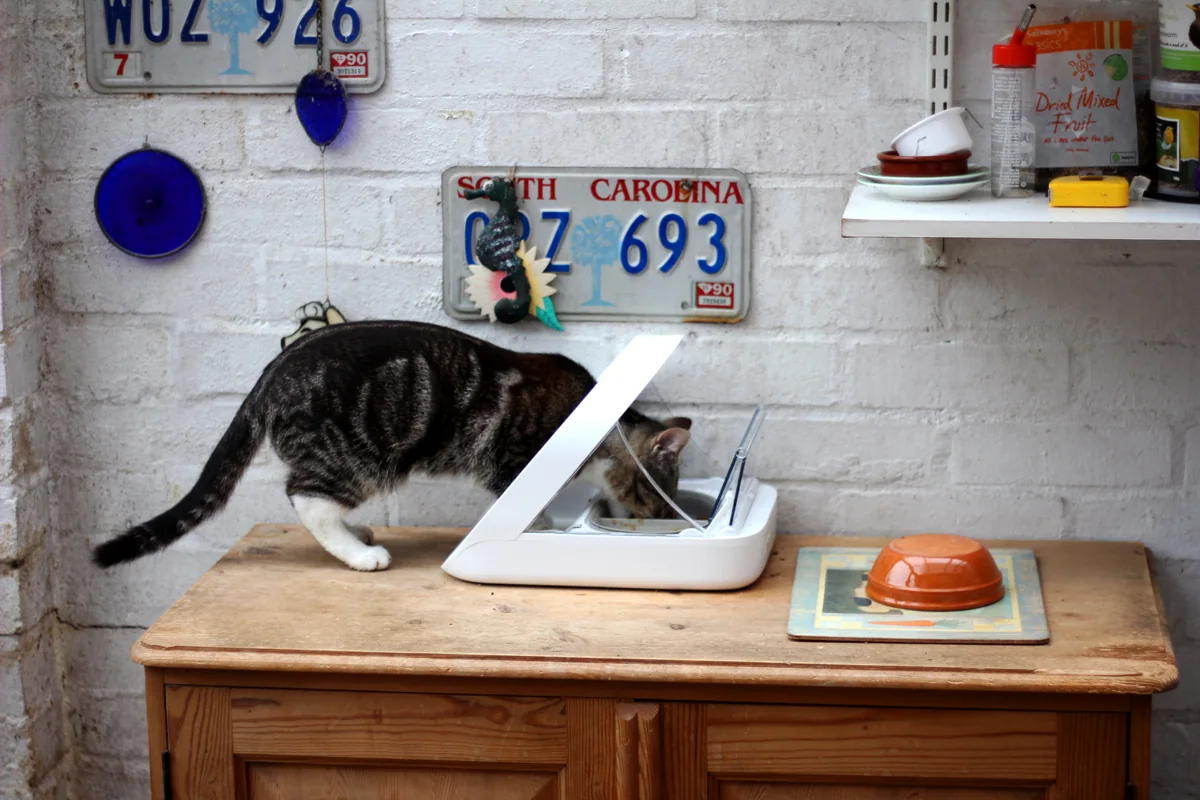
In a multi-pet home, the most expensive part of feeding can be the uncertainty about who ate whose meal. The SureFeed Microchip Pet Feeder addresses access to a bowl by identifying an authorized animal. This feature is based on manufacturer information checked October 14, 2026. Pet Living Magazine has not tested identification accuracy, lid operation, training time, or resistance to food theft.
The verified basics
Sure Petcare says this feeder works with identification microchips and its RFID collar tags, and includes one tag. The listed bowl capacity is 400 milliliters; the feeder accepts wet or dry food. Manufacturer dimensions are 200 millimeters high, 230 wide, and 320 deep. It requires four C-cell batteries, not included. Consult the official model page for current compatibility and operating instructions. This coverage concerns the Microchip Pet Feeder, not the separate Connect model.
Access control is a specific tool
Selective access can be useful when animals have different foods or when one pet regularly visits another’s bowl. It does not decide the appropriate diet or portion. You still measure the food, observe intake, and follow the veterinary plan when a prescription diet is involved. Treat the device as part of the feeding arrangement, rather than as proof that the right animal consumed every serving.
Consider the physical fit too. A pet must be comfortable approaching the feeding area and placing its head in the required position. Measure the available floor space and look at the access opening. The total footprint matters when a feeder needs a quiet corner with room for the animal to leave.
Plan for the introduction
A moving lid is an unfamiliar event for many pets. Read the manufacturer’s training instructions before removing the existing feeding option. Let the animal progress at its own pace, watch whether it is actually eating, and ask for help if the setup creates persistent avoidance. One hungry pet should not have to complete a learning challenge before a meal can happen.
Also observe the other animals. A determined companion may approach from behind or hover close to the authorized pet. Placement and supervision still matter. Decide where a second feeding station would go if the selective feeder alone does not solve the conflict. A separate room may remain the simplest solution in some homes.
Ownership beyond the purchase
Check cleaning instructions, replacement bowl availability, battery access, and the procedure for adding or removing an animal’s identifier. Label the feeder if several identical units are installed. Include an ordinary feeding fallback in the sitter instructions, because equipment problems do not pause an animal’s need to eat.
Our research assessment favors this model for a clearly defined access problem and a household willing to supervise the transition. It is less compelling if your main requirement is scheduled dispensing, remote monitoring, or automatic portion measurement. We have not scored its performance. Verify current price and stock directly, and compare the precise model name at checkout so a useful feature does not become an expensive misunderstanding.
Prepared with AI assistance and source checks. General editorial information; no veterinarian-review claim. Report a correction.