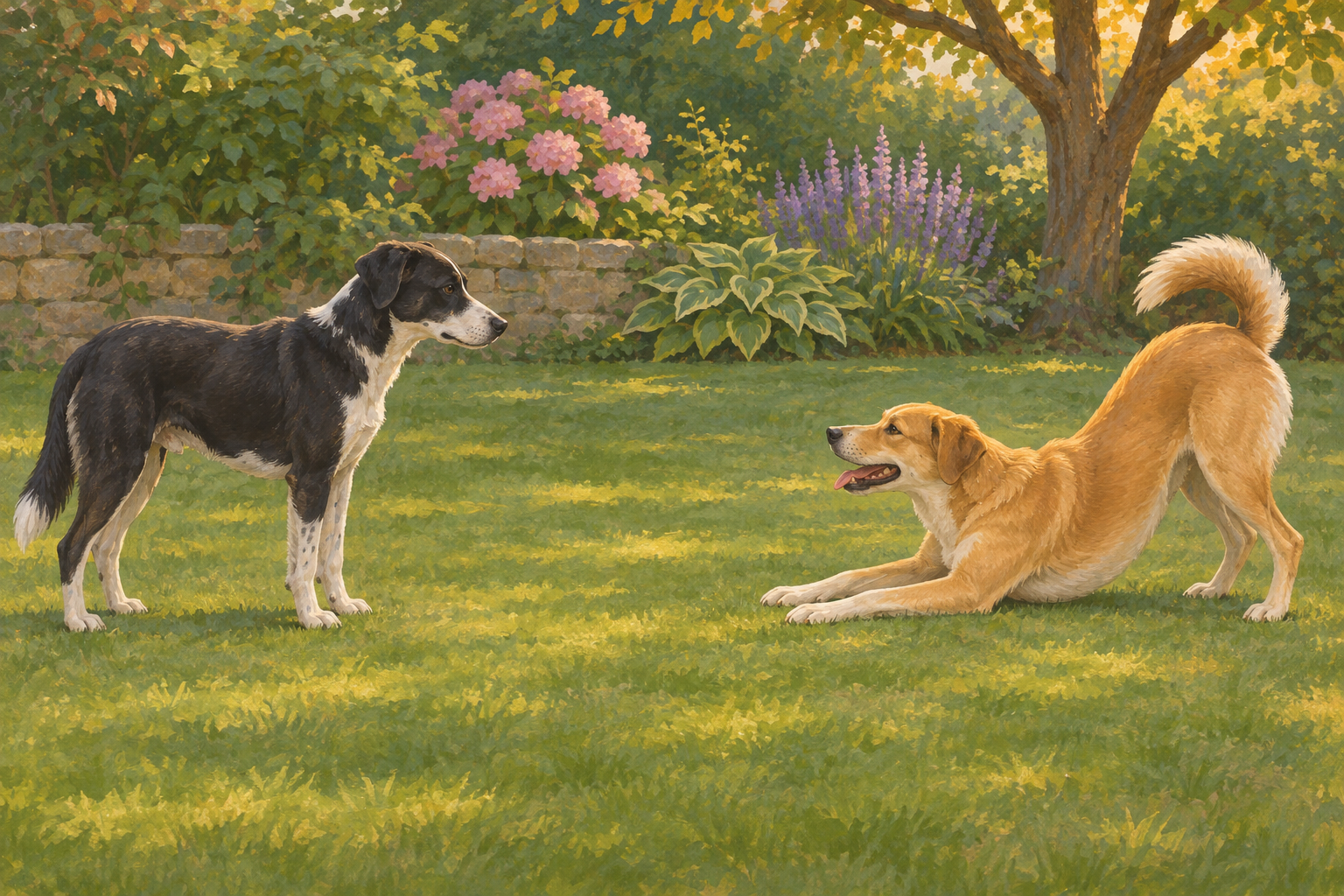
A dog lowers its chest, keeps its hindquarters up, then springs away. A snapshot catches the bow. Watching the few seconds on either side tells you more about what just happened. Did both dogs slow down first? Did the second dog chase, stay still, or turn away? The bow is one dog's action. What follows depends on both dogs.
Two observational studies by Sarah-Elizabeth Byosiere and colleagues approached canine play this way. Instead of counting every bow as the same message, they looked at what the dog offering the bow and its partner did immediately before and after it. That approach is useful for anyone who has wondered how two dogs resume a game after a lull.
In adult dogs, the bow often followed a pause
In a 2016 study in Behavioural Processes, Byosiere, Julia Espinosa and Barbara Smuts coded the actions around play bows in pairs of pet dogs. Brief pauses were common just before a bow. Afterward, some dogs moved together. In other cases, the dog that bowed ran away and its partner chased. The researchers interpreted the pattern as evidence that the bow can help restart play after a pause.
That interpretation depends on the order of events. A bow followed by a run looks different if you began watching during the run. Similarly, a dog standing still after its partner bows is easy to miss if you are only watching the animal making the bigger movement. The study looked at a window around the bow so it could account for both sides of the exchange.
Puppies also changed pace after a bow
In a separate PLOS ONE paper, the researchers and their coauthors compared play bows in dog puppies and wolf puppies. They recorded 136 bows by 10 dog puppies. In the dog sample, both participants were more active after bows than before them. The researchers also found that the puppy pairs rarely moved in synchrony around bows, even though matched movements had been more common in the adult study. Look for the change in activity before drawing conclusions from how alike the two dogs' movements appear.
Those 136 observations came from 10 dogs, with individual animals observed more than once. The number of bows describes how much behavior the authors coded. It does not tell us how an unfamiliar dog will respond the first time it meets another dog. The studies examined bows during play, so their results do not show that any similar crouch, in any setting, will restart a game.
Describe what each dog did next
Imagine two familiar dogs already playing in an open yard. Both stop after a short chase. The tan dog lowers its front end, straightens, and runs. The white dog follows. In another exchange, the tan dog bows and runs, and the white dog walks away. In a note or a conversation, those are two different sequences. Simply recording “the tan dog wanted to play” leaves out the part where the other dog makes a choice.
If you happen to see play between dogs that already know each other, try describing one exchange in plain language. What were both doing before the bow? Which dog moved first afterward? Did the other join, stand still, or leave? Stop watching when you need to attend to the dogs. You can learn from an ordinary interaction without arranging one for the sake of the observation.
Keep the option to leave
Let a dog that walks away take its break. A bow doesn't tell you how another dog feels, and the papers don't give owners a test for whether an encounter is safe. If you're unsure about how two dogs are interacting, give them space and ask a qualified professional who can assess the dogs and the setting. The guide to leaving room on walks explains how to choose a route where you can give dogs more space before they meet.
A day without dog-to-dog play can still offer opportunities to explore and engage. The magazine's enrichment menu for dogs offers ways to build in exploration, quiet activities, and play with a person. At the next chance to observe two familiar dogs, pay attention to the quiet moment between bursts of movement. It may help you notice who starts the next round and whether anyone else joins.
Editorial note: Prepared with AI assistance using the two primary studies linked above, checked November 25, 2026. The yard examples are hypothetical. No veterinarian reviewed this article. The featured image is an original AI-created illustration of a fictional scene.
Prepared with AI assistance and source checks. General editorial information; no veterinarian-review claim. Report a correction.