One pet-food label lists calories per cup. Another emphasizes calories per can. Both also show a much larger number per kilogram. Before comparing the numbers, identify what quantity of food each describes. A smaller printed number does not by itself mean a less energy-dense food.
The arithmetic below translates units. It does not calculate how many calories your dog or cat needs, prescribe a portion, or establish that two foods are nutritionally interchangeable. Use the exact product's information and your veterinary team's feeding plan when making a real change.
Find the calorie statement and its units
AAFCO's consumer guidance describes calorie content expressed as kilocalories per kilogram of food as fed and per familiar unit such as a cup, can, or biscuit. The calorie statement is distinct from the guaranteed analysis. WSAVA's annotated North American food-label example likewise identifies the calorie-content section and household-measure units.
Copy the full statement with its units. Do not write only “350.” Add the exact formula, package size, and whether the figure is per cup, per can, or per kilogram. Photograph the current package so you can check your transcription. An online listing for another size or recipe is not a substitute.
For broader questions about life-stage suitability and the adequacy statement, use the pet-food label reading guide. Here the narrower task is to keep the calorie calculation from mixing unlike quantities.
Convert a kilogram figure to calories per gram
A kilogram contains 1,000 grams. Divide the kcal/kg figure by 1,000 to obtain kcal/g. Then multiply by the grams of that food to find the calories represented by that amount. Keep the units written alongside each step so a misplaced decimal is easier to spot.
Invented arithmetic example, not a feeding recommendation: a hypothetical dry food labeled 3,500 kcal/kg provides 3.5 kcal/g. Forty grams of that hypothetical food represents 40 × 3.5 = 140 kcal. The example does not imply that 40 grams is an appropriate meal or daily ration for any animal.
You can check the same calculation another way: 40 grams is 0.04 kilograms, and 0.04 × 3,500 is again 140 kcal. If your two methods disagree, stop and check the conversion before using the result. Avoid rounding a decimal away at the first step.
Keep a cup attached to its own food
A cup is a volume measure; a gram measures mass. Do not assume that one cup of every kibble weighs the same. If you need to relate a cup direction to grams, obtain the relevant information for that exact product and clarify the measuring method with the manufacturer or veterinary team.
Here is a second invented example: Food A supplies 320 kcal/cup and Food B supplies 400 kcal/cup. The same one-cup volume of B represents 80 more kcal. That calculation compares those stated cup quantities. It does not tell you which food is appropriate, how much your pet should receive, or how to make a diet transition.
Do not carry an old scoop instruction to a replacement food by habit. If the clinic specifies a quantity in grams, use the agreed measuring method and product. A scale can display a precise number while the underlying calculation still refers to the wrong food.
Read “per can” literally
Suppose a hypothetical can is labeled 180 kcal/can. Half of the food in that can represents 90 kcal if it is divided equally by amount. Two complete cans represent 360 kcal. Those are calculations about that particular container, not comparisons with an unidentified “serving” on a different package.
Check can size before comparing another flavor or shopping format. A per-can figure can change because the container size changes. Do not confuse ounces of package weight with fluid ounces, or turn a per-can figure into calories per gram without the necessary mass information. Ask rather than filling a missing conversion with a guess.
Separate a calculation from a feeding decision
Your worksheet needs only five entries: exact food, label calorie figure with units, amount being described, conversion if needed, and the resulting calories. Add “illustrative” to practice examples and keep them away from current feeding instructions. In a household with several feeders, only the agreed plan belongs by the bowl.
Take unresolved units to the manufacturer or veterinary team. Ask how the complete daily plan accounts for mixed foods, rewards, and other extras. The diet-history guide helps capture what is actually offered before that conversation.
Finally, repeat the label check when the formula or package changes. Save the old entry with its date and identify the current one clearly. The useful result is a calculation another person can verify from the package, followed by a feeding decision made for the individual animal.
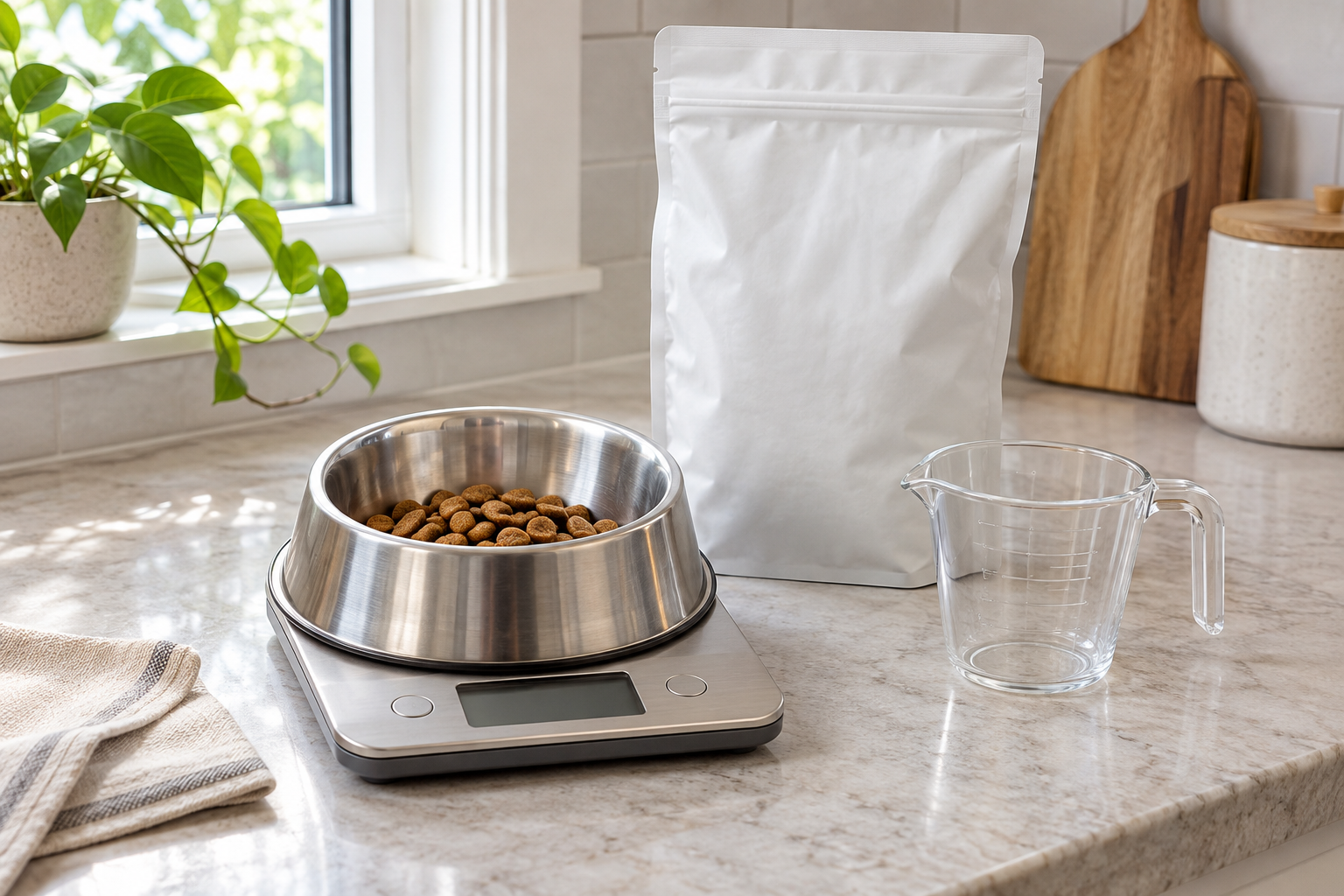
Editorial note: Prepared with AI assistance using the primary label resources linked above. All numerical food examples are invented for unit arithmetic and are not feeding prescriptions. This article has not been reviewed by a veterinarian. The featured image is an original AI-created still life; its bowl contents do not demonstrate a recommended portion.
Prepared with AI assistance and source checks. General editorial information; no veterinarian-review claim. Report a correction.