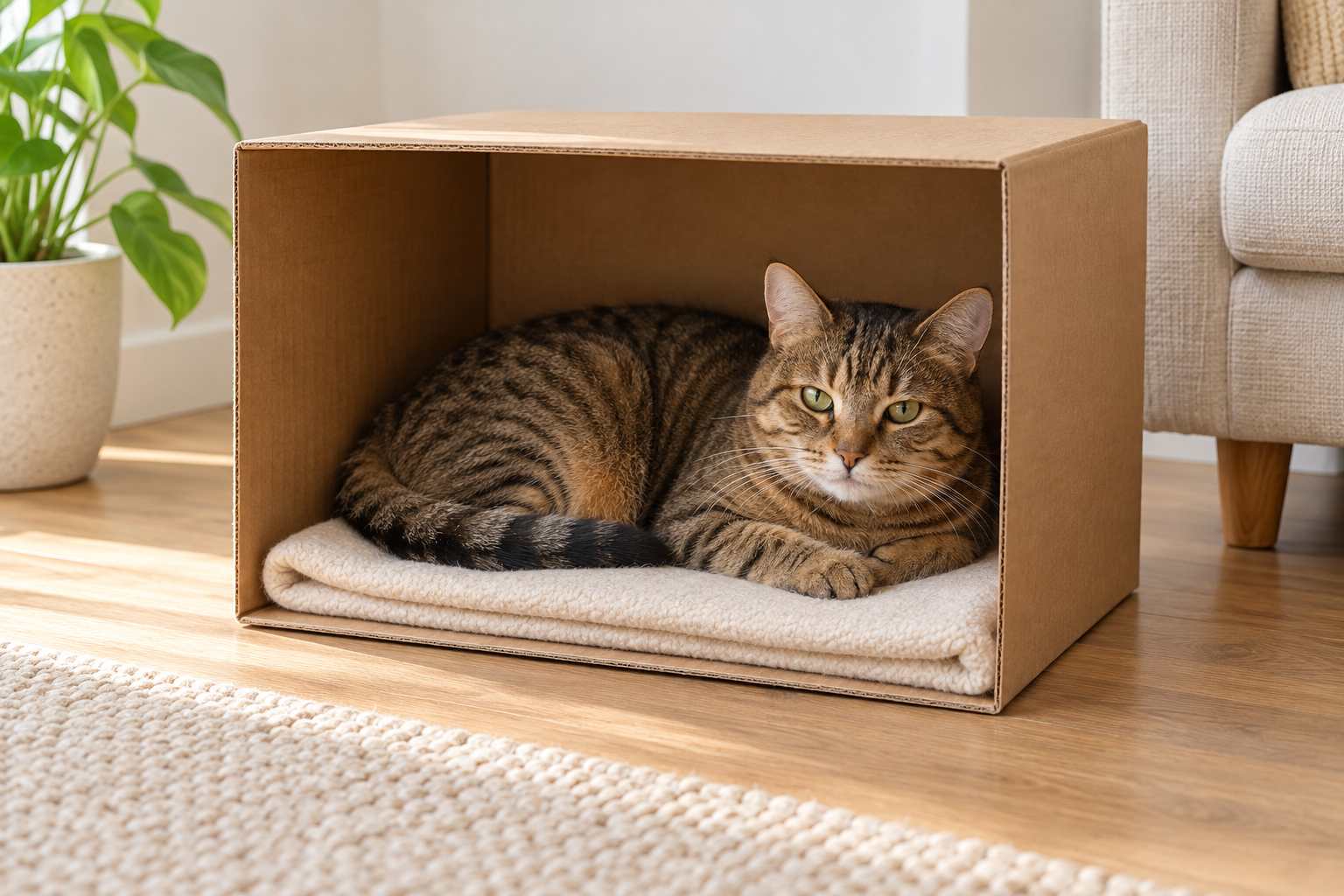
A cardboard box can look like a finished cat project before the cat has even seen it. Yet a beautifully lined hideaway beside the vacuum cleaner may be less useful than an ordinary box in a corner the household agrees to leave alone. Before decorating anything, decide what the space is supposed to offer: a place your cat can enter, leave and use without an audience.
This practical home exercise focuses on location and household habits. It does not require buying a bed or persuading your cat to use the newest object in the room. It starts with a question you can answer by looking around: if the house becomes busy, where can the cat withdraw without someone following?
Separate a resting choice from a change in behavior
Cats Protection explains that hiding can be ordinary feline behavior, but an increase can also accompany stress or illness. A new hideaway is not a substitute for veterinary attention when your cat starts hiding more than usual. Contact your veterinarian about a change, especially if eating, drinking or toileting also seems different.
The charity recommends quiet hiding places away from food, water and litter, and advises leaving a worried cat alone rather than repeatedly coaxing them out. Treat those as the starting conditions. The goal is to provide a usable choice, not to explain a medical or behavioral change yourself.
Walk the room before choosing the box
Try a short location review when the room is empty. List two possible corners, then describe each as if another person needed to find it without a photograph. “Behind the armchair, clear of the door's swing” is more useful than “somewhere cozy.” Add the ordinary activity nearby: television, laundry sorting, passing feet or a door that opens frequently.
Return when the household is using the room. A spot that looked secluded at breakfast may become the shortcut to the kitchen by evening. This second look is a planning exercise, not a test of your cat. You can rule out an awkward location without placing the animal there first.
Then describe the approach. Can the cat reach the opening without weaving through stored bags or another animal's resting place? Our multi-cat resource map offers a broader way to examine those shared routes. Keep that whole-room view in mind while making one small change.
Keep the construction modest
Woodgreen's hideaway instructions specify a cardboard box large enough for a cat to sit comfortably and turn around. They describe a box on its side with a blanket inside as part of a simple home setup. Size and easy access matter more than whether the finished object matches the room.
For this version, begin with a plain, sound box and a flat lining. Check it for unwanted packaging, loose fastenings and damage before offering it. Keep the entrance open and the box stable. Skip elaborate decorations; they add another thing to inspect without answering the main question about location.
If you are considering a raised option, assess the support and access separately. A box should not turn an ordinary shelf into an improvised structure. See our guide to mapping vertical space for an indoor cat before changing elevated routes.
Give the hideaway a household rule
Battersea's cat-friendly-home guidance emphasizes predictable access to resources, opportunities to retreat and a cat's choice over contact. It recommends keeping important resources in quiet, consistent locations and offering more than one option. A single new box does not replace the rest of that environment.
Make those ideas concrete with one sentence everyone can repeat: “When the cat is in the box, leave them alone.” Discuss it with children and visitors before the room becomes busy. Do not turn the hideaway into a place to photograph, touch or retrieve the cat for a social introduction.
Review the arrangement without grading the cat
After a few ordinary household days, write down only what you have observed. Record which location you offered, when the room was busy and whether the cat approached, rested there or chose somewhere else. “Unused while we were watching” is an observation; “the cat hates it” is an interpretation.
Keep changes small enough to understand. If the doorway proved awkward, reconsider that location before adding a second layer of decoration. If the box becomes damaged or soiled, replace or clean the setup as appropriate rather than preserving it because it was your project. A useful hideaway earns its place by remaining a practical choice in the cat's home.
Prepared with AI assistance and primary-source checks on October 26, 2026. This is general editorial information, not an individual veterinary assessment. The featured scene is an AI-created illustration.
Prepared with AI assistance and source checks. General editorial information; no veterinarian-review claim. Report a correction.